
To make a business eligible for ChatGPT search citations, allow OAI-SearchBot through robots.txt and infrastructure, keep public pages accessible, and publish accurate facts with clear sources. Manage GPTBot separately if training use matters. Then track cited URLs, factual accuracy, and referrals carrying the documented ChatGPT parameter, while recognizing that placement is never guaranteed.
- OpenAI identifies OAI-SearchBot for ChatGPT search discovery and GPTBot separately for potential training use.
- Allowing the crawler makes a page eligible for consideration but does not guarantee inclusion or placement.
- Authoritative product facts, visible evidence, and referral analytics are more defensible than attempts to influence training data or plant mentions.
Step 1: Check ChatGPT search access

OpenAI's publisher FAQ says public sites can appear in ChatGPT search and instructs publishers to allow OAI-SearchBot for content to be included in summaries and snippets. Check robots.txt, CDN rules, firewall controls, and successful responses.
Access is necessary for eligibility, not a promise that the page will appear. Keep a dated record of the test.
Step 2: Publish a source worth linking
Create an authoritative page for the business fact or question. State what the product does, who it serves, current limitations, price or plan conditions where public, and the date of information that can change.
Use plain language and primary evidence. There is no documented requirement for a forty to one hundred twenty word answer block.
Step 3: Organize business information coherently

Maintain a clear company page, product or service pages, documentation, policies, and focused guides. Use internal links to connect related material for readers. Merge pages that repeat the same claim.
A minimum page count does not establish authority. Coverage should follow real customer tasks.
Do not confuse ChatGPT with other assistants
ChatGPT search has its own crawler and may use search providers. Claude, Gemini, and Perplexity have different products and controls. Results and source preferences can vary by query and mode.
Test each platform independently instead of publishing unsupported percentages about media ownership or citation allocation.
Treat community sources as independent spaces
Reddit, Wikipedia, trade forums, and industry publications have their own editorial and community rules. Contribute only when you can add relevant information and disclose affiliation where needed.
Do not present planted posts or manufactured brand mentions as a way to train ChatGPT.
Do the assistants your buyers ask name you, or a competitor?
Reads your site, then asks four assistants what your customers ask.
Build authority through verifiable facts
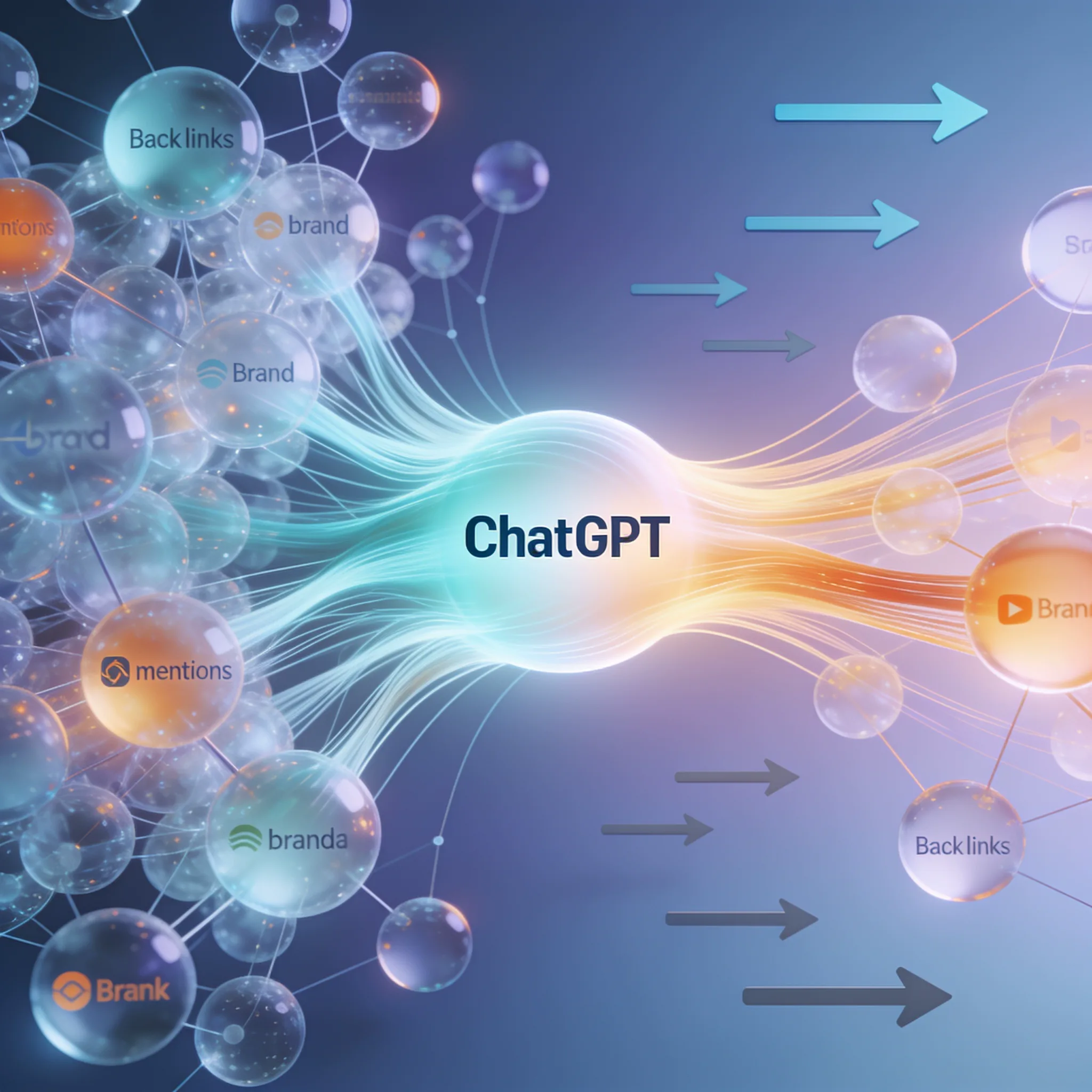
Backlinks, mentions, coverage, and owned content can all be outcomes of useful work. No OpenAI documentation says unlinked mentions are the true authority signal or provides a multiplier against links.
Publish documentation or research others can cite, then let independent sources assess it.
Review citations as a maintenance loop
Run important business questions on a stable schedule. Log citations, mentions, factual errors, and source pages. Correct the authoritative page when details change and review conflicting profiles.
Keep the prompt sample and limitations visible in reporting.
Measure referrals and pipeline carefully
OpenAI says ChatGPT referral URLs include the parameter `utm_source=chatgpt.com`. Use it with ordinary analytics controls, while accounting for consent settings, redirects, and sessions that do not convert immediately.
Do not estimate revenue from prompts or citations alone. Report observed sessions, qualified leads, and sales using the attribution model the business already accepts.
Find out what ChatGPT says about you before your next buyer does.
Free, no account. The paid audit is $490 and takes 3-5 business days.
Frequently Asked Questions
