
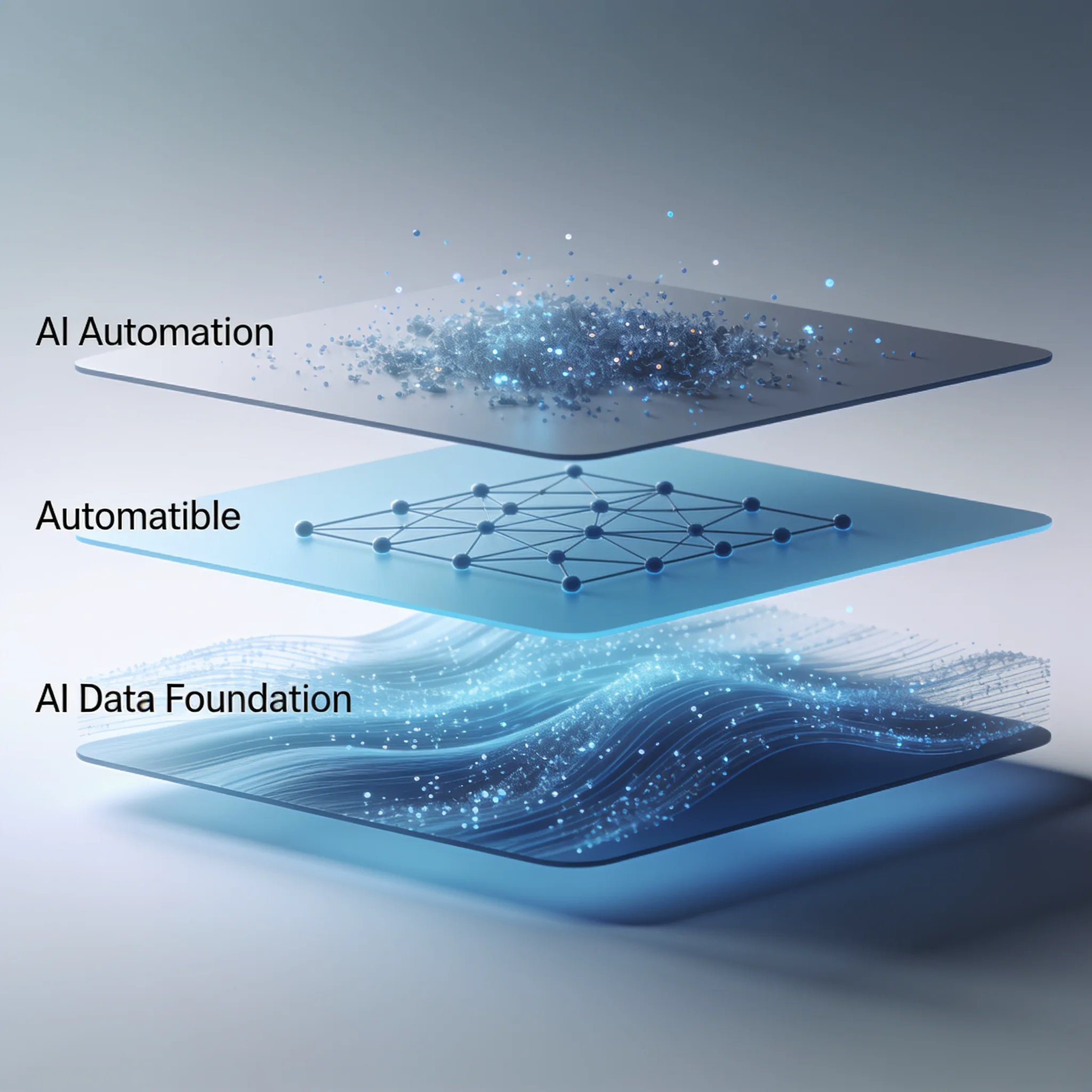
AI automation layers run from a clean data foundation up to autonomous, event-driven operations, and each one only works if the layer beneath it does. Most teams stall at Layer 3, where advisory AI becomes executable, and the cause is almost always data quality rather than model capability.
- The industry lacks standardization, but unifying the 3, 5, and 6-layer models reveals a clear progression from Data Foundation to Autonomous Operations.
- 80% of teams stall at Layer 3 (Decision Logic) due to unstructured data from Layers 1 and 2, proving that data quality is a bigger barrier than technology.
- Scaling from Level 1 individual tools ($45-$120/mo) to Level 3 multi-agent operations ($400-$800/mo) requires deliberate architectural shifts and strict governance.
What Is the Unified AI Automation Layers Framework?

The Unified AI Automation Layers framework is a vendor-agnostic progression model. It bridges fragmented 3, 5, and 6-layer architectures into a single, incredibly clear path for operators. We map the 5-Layer Automation Stack to the Six-Layer Agent Stack to define AI maturity from Data Foundation up to Autonomous Operations, ensuring that technical execution and cognitive maturity advance together.
Both groups must align.
The 5-Layer Automation Stack includes Data Capture, Pipeline Orchestration, Decision Logic, Intelligent Actions, and Autonomous Agents. We map these operational components to the Six-Layer Agent Stack framework (which defines AI maturity from Data Foundation up to Autonomous Operations) to ensure technical execution and cognitive maturity advance together. Historically, data engineering teams operated on the 5-Layer model while machine learning teams built against the 6-Layer model, creating a massive communication gap.
Data teams focused on moving bytes while ML teams focused on reasoning loops. By unifying them, we force both groups to align on a single milestone gate, which mandates that if the data team cannot prove the 5-Layer Pipeline Orchestration handles edge cases, the ML team cannot proceed to 6-Layer Tool execution.
Layer 1 (Data Foundation) is where data exists in disconnected silos without a unified AI query layer. Teams spend weeks writing custom scripts to answer basic operational questions, and this manual approach is the starting point for most enterprises. The failure mode here is assuming a warehouse solves it.
We see companies dump raw CSVs into Snowflake and proudly call it Layer 1. That is a trap. If an AI agent has to write custom SQL to parse unstructured text fields just to find a customer ID, you are still in silos.
An agent that acts on stale inventory data can order unavailable stock or miss a sales spike. Test freshness requirements, late-arriving events, and reconciliation before allowing the system to place an order.
Layer 3 (Tool Layer) involves AI that can query data but cannot take actions in external systems, making intelligence advisory rather than executable. This is where most teams hit a wall.
Layer 4 (Memory Layer) provides agents with persistent context across sessions, allowing them to learn from past outcomes and stop repeating known errors. They remember user preferences and prior failures. The edge case that breaks this layer is state bleed, which occurs when an agent remembers a specific user discount code and accidentally applies it to a new user session, creating a data leak.
Memory layers require strict namespace isolation per user.
Layer 5 (Orchestration Layer) enables multiple specialized agents to work together on complex tasks through sequential, parallel, or hierarchical patterns. This is multi-agent architecture. Teams often try to skip Layer 4 and jump straight to Layer 5, which means their agents cannot retain state between their own sequential tasks.
You end up with orchestration loops where agents constantly ask each other for data they already retrieved, multiplying your token costs by a factor of 10 and destroying your ROI.
Layer 6 (Autonomous Operations) involves AI agents continuously monitoring data, detecting events, reasoning over datasets, and taking action without human initiation. This is the end goal.
Step 1: Diagnose Your Current AI Automation Layer
Most automation projects fail because teams skip foundational layers or start at the wrong one in the automation stack. You must baseline your current state before adding agents.
We use a strict self-assessment checklist to diagnose starting points, and this prevents over-engineering a solution before the basics are live. Run through this list to check your readiness.
- Data Latency: Verify how long it takes to aggregate core operational data. Are you taking hours? Then you are stuck in Layer 1.
- Query Structure: Check if your data requires human-initiated prompts to generate insights, because if AI cannot query the database autonomously, you are in Layer 2.
- Action Permissions: Audit your API scopes. If your AI can read data but lacks write access to external systems, you have definitively hit the Layer 3 ceiling.
- Context Persistence: Test session memory. If your agent forgets prior interactions when a new session starts, you lack Layer 4 capabilities entirely.
A pipeline that looks adequate for reporting may still fail when software takes action from its data. Test schema changes, missing fields, stale records, duplicate events, and downstream API errors before enabling writes.
Use the assessment below to baseline your organizational maturity.
Why Decision Automation Stalls on Weak Data
The Layer 3 stall occurs when teams try to build automated decision logic without first cleaning their foundational data. A significant percentage of teams fail at this stage because their data quality is too poor for AI to reason over reliably, making structured data the true barrier to progression.
The most common barrier to moving from Layer 2 to Layer 3 in AI automation is data quality, not technology. This failure rate exposes a widespread delusion.
Teams buy enterprise automation tools before cleaning their data lakes, wrongly assuming the AI model will figure out messy schemas. It will not. AI cannot reason over unstructured garbage without massive token consumption and hallucination risk.
The Layer 3 stall is actually a data architecture failure masquerading as an AI limitation.
| Maturity Layer | Failure Mode | Primary Cause | Resolution Path |
|---|---|---|---|
| Layer 1 | Query Timeouts | Siloed Databases | Centralize Data Capture |
| Layer 2 | Irrelevant Output | Static Reports | Add Vector Embeddings |
| Layer 3 | Hallucinated Actions | Unstructured Inputs | Enforce Data Quality SLAs |
| Layer 4 | Context Loss | Missing State Stores | Build Persistent Memory |
If your AI produces confident but incorrect actions, you do not have a model problem. You have a data problem. Fix the inputs before tuning the outputs.
Step 2: Architecting the Technical Stack Across Vendor Ecosystems
AI automation stack levels can be broken down into Trigger, Data input, AI processing, and Output routing. You need different tools as you scale through these stages.
Level 1 AI automation typically uses Claude Pro or ChatGPT Plus with a shared workspace like Teams. This level handles basic drafting and summarization, and the architecture here is non-existent. You rely on copy and paste, so the primary failure mode is context loss.
A user pastes a long thread into the LLM, but the tool truncates the history, leading to incomplete summaries.
Level 2 AI automation involves API tools and automation platforms like Make Business or Zapier Professional. These platforms connect your CRM to your AI model. This level costs approximately $150 to $350 per month, and the obvious choice here is to use Zapier because it has native integrations for everything.
The trade-off it hides is the polling limit. Zapier polls APIs on a 15-minute cycle on standard plans, so if your customer data changes, your AI agent will not know for 15 minutes, breaking the Layer 1 latency requirement of under 5 minutes. You must use webhook-based triggers instead of polling to maintain real-time context.
Level 3 connected multi-agent operations require multi-step agent frameworks and enterprise automation tools like n8n. It handles branching logic and complex routing. n8n requires self-hosting or enterprise cloud plans, which shifts your cost from software licenses to DevOps engineering time.
The failure mode here is assuming your standard IT team can maintain a self-hosted n8n instance without dedicated infrastructure monitoring for your automation nodes. Otherwise, a memory leak in a single workflow will bring down your entire agent platform.
Here is a standard JSON webhook payload for Level 2 automation routing into an AI processing node:
{
 "trigger": "stripe.invoice_payment_failed",
 "data_input": {
 "customer_id": "cus_12345",
 "amount_due": 4900
 },
 "ai_processing": {
 "model": "claude-opus-5-5",
 "task": "Draft a context-aware recovery email."
 },
 "output_routing": {
 "action": "send_email",
 "platform": "sendgrid"
 }
}
When the AI processing node receives this payload, it uses the `task` parameter to select a specific prompt template. If Stripe changes their API payload structure and adds a nested object for `amount_due`, your AI model might hallucinate the value and draft an email for $0. We mandate semantic versioning for prompt templates to prevent regressions.
When you update a prompt to handle the new Stripe payload structure, you increment the version number.
If the new prompt causes hallucinations in production, you simply roll back the version instantly without touching the codebase. You also isolate the AI processing node behind a queue like RabbitMQ. If Sendgrid goes down, your webhook should not fail.
The queue holds the payload and retries the output routing until the external API recovers.
Calculate your baseline costs to build a Level 3 stack using the calculator below.
AI Automation Cost Calculator
Estimate monthly costs across different ai automation layers.
Ready to see what AI can do for your operations?
Delivers in 3-5 business days. No commitment required.
Step 3: Implement Security and Governance for Autonomous Operations
Layer 3 (Tool Layer) involves AI that can query data but cannot take actions in external systems, making intelligence advisory rather than executable. Layer 6 (Autonomous Operations) involves AI agents continuously monitoring data, detecting events, reasoning over datasets, and taking action without human initiation.
This jump from advisory to executable creates massive security risks. You must implement governance protocols for when AI agents take executable actions in external systems.
The comparison people reach for is electricity. Even electricity needs a grounded breaker box. Your autonomous agents need the same circuit breaker architecture.
We require human-in-the-loop guardrails for any action that involves financial transactions or data deletion. The system must pause and verify.
Set up strict rate limits and role-based access control for your agent tokens. An agent that can issue refunds should not have write access to your source code repository. Use scoped API keys that expire every 24 hours.
Uncommon Insight: Why Memory and Orchestration Layers Are Overrated Without Clean Data
The market pushes advanced multi-agent setups as the holy grail of ai automation layers. We strongly disagree. Investing in Layer 4 and Layer 5 is entirely futile if Layer 1 remains flawed.
Layer 4 (Memory Layer) provides agents with persistent context across sessions, allowing them to learn from past outcomes. But if the underlying data is corrupt, the agent just memorizes failures. A multi-agent system running on bad data simply scales failure faster than a single agent ever could.
The most common barrier to moving from Layer 2 to Layer 3 in AI automation is data quality, not technology. This extends upward. Bad data poisons every single layer above it.
Data architecture must precede AI architecture. Stop buying orchestration tools before you fix your CRM schema, because a simple script on clean data beats a multi-agent system on garbage data every time. Build a better chain by fixing your foundation first.
Mapping AI Automation Layers to Business ROI and Change Management

The 5-Layer Automation Stack includes Data Capture, Pipeline Orchestration, Decision Logic, Intelligent Actions, and Autonomous Agents. Connecting these technical layers to business outcomes is how you secure executive buy-in.
This speed alone reduces customer support resolution times dramatically.
Use a hypothetical ticket triage workload to model the stack before a pilot. Enter the organization's own volume, handling cost, software fees, model usage, review time, and error cost. The break-even point should be calculated from observed inputs, not presented as a client result.
Progressing from Layer 1 to Layer 5 takes an average of 14 months for most enterprises. Do not expect overnight transformations. Build a change management plan that trains your team on the new automation stack.
A triage pilot can create staff resistance when success is framed only as ticket throughput. In a hypothetical rollout, the team could measure complex issues resolved and correction quality while the system handles routine classification. Survey staff and publish the actual outcome only after the pilot.
A rollout plan should identify which cases remain with staff and which skills they need for validation, exception handling, and system ownership. Record training time and role changes from the actual rollout rather than inventing a staffing result.
If you skip this change management step, your team will actively sabotage the data foundation, and they will input unstructured notes instead of using dropdown fields. They will bypass the CRM and track deals in spreadsheets, ensuring that a multi-agent system running on sabotaged data will fail instantly. That is the shape of ai automation layers in practice.
Stop guessing. Start building with a clear roadmap.
Fast delivery. Measurable outputs. Security-first.
Frequently Asked Questions
